
A medium-sized heat staking machine is a PLC-controlled plastic riveting system for assemblies that need multiple heated stake points, accurate part support, controlled pre-pressure and repeatable cooling in a production-sized work area. Jfortune Precision Machinery Co., Ltd. designs the tool, nest, heating points, controls and safety system around the buyer’s actual plastic parts and acceptance requirements.
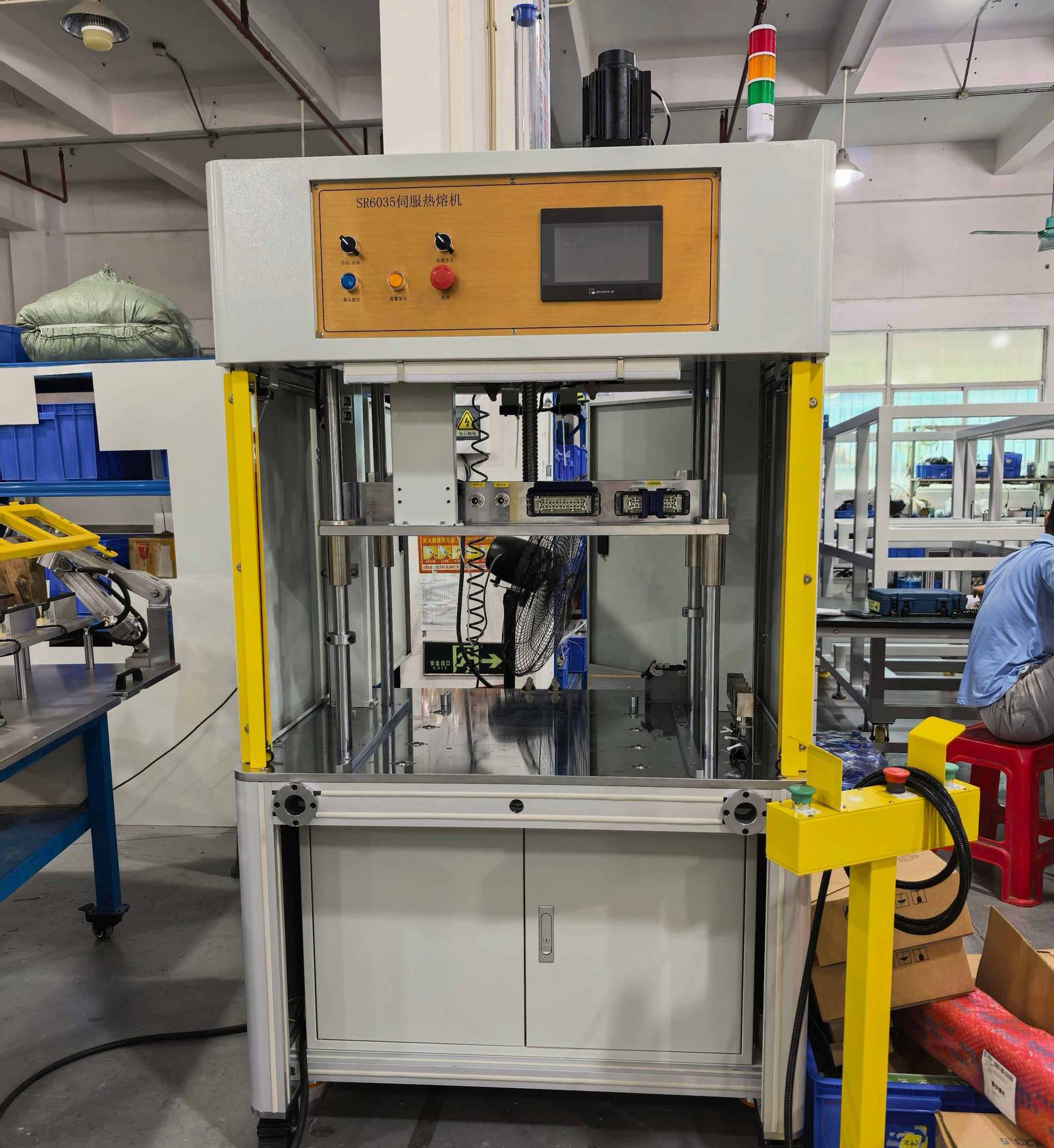
Medium-Sized Heat Staking Machine at a Glance
- Process: controlled heating, forming, holding and cold-air cooling of thermoplastic stakes.
- Drive: pneumatic cylinder for vertical platen movement.
- Tooling: independently adjustable heat staking points with a guided upper tool and part nest.
- Part protection: CNC-machined ABS nest and pre-pressing units help support the assembly without damaging visible surfaces.
- Controls: PLC and touch-screen HMI with manual/automatic modes, temperature settings, production count, password protection and recipe management.
- Safety: emergency stop, safety light curtain and project-specific start-button arrangement.
What Is a Medium-Sized Heat Staking Machine?
A medium-sized heat staking machine joins a plastic component to another plastic, metal or electronic component by heating and forming molded thermoplastic posts. The formed stake heads mechanically retain the assembled parts. Unlike a general-purpose press, the machine must control the position, temperature, forming pressure, holding time and cooling of every staking point.
“Medium-sized” should not be selected from the machine footprint alone. The correct machine is determined by the part dimensions, number and position of the stakes, upper tooling mass, required working stroke, loading method, cycle target and safety clearance. Jfortune confirms the machine layout only after reviewing the released drawings or representative samples.
This equipment is suitable for manufacturers that need a production heat staking solution with more process control and guarding than a benchtop unit, but do not require an oversized transfer line. Typical projects include automotive interior trim, door panels, instrument-panel components, lamp and electronic housings, appliance assemblies and other thermoplastic products with multiple plastic rivet posts.
How the Heat Staking Cycle Works
- Load and verify the parts. The operator places the components in the dedicated nest. Optional sensors and barcode verification can confirm that the correct part and program are selected.
- Pre-press the assembly. Adjustable pre-pressing units bring the upper and lower components into contact and remove assembly gaps before the stakes are formed.
- Heat and form the stakes. The pneumatic platen moves the heat staking tool downward. Heated tips soften and form the thermoplastic posts into the specified head geometry.
- Hold and cool. Cold air is directed to the staking points while the assembly remains supported. Controlled cooling helps the stake heads solidify quickly and can reduce stringing.
- Return and unload. The tooling returns to its safe position, the completed part is removed and the cycle count is updated.
Heating temperature, forming time, pressure, holding time and cooling time must be established from the polymer, stake geometry and quality requirement. Final settings are validated with customer parts during tooling trials and acceptance testing.
Heat Staking Tooling Designed for Accurate Adjustment
The upper heat staking tool is fixed to the moving equipment platen with bolted connections. Each staking point can be micro-adjusted independently in the horizontal and vertical directions. This adjustment is important when molded-part variation, stake height or part distortion would otherwise produce uneven contact across a multi-point assembly.
Jfortune integrates pre-pressing devices into the tooling so the mating parts remain fully seated during staking. The upper tool and lower nest are aligned by guide pillars and bushings and secured by bolts. This guided construction helps maintain repeatable positioning during tool installation and production.
A removable cold-air manifold directs cooling air to each formed stake. Faster, controlled solidification is intended to produce a cleaner stake head and reduce material stringing. The actual appearance depends on the resin, fillers, stake design, tip geometry and validated process window.
CNC-Machined ABS Part Nest
The part nest is manufactured from ABS in CNC-machined sections. The material and segmented machining approach are selected to support accurate positioning while protecting the product’s visible surface during loading and unloading. Nest material, support points, locating pins, sensors and replaceable wear areas are finalized for the specific component.
For appearance-sensitive automotive parts, Jfortune reviews the A-surface, locating strategy, permitted clamp areas and removal direction before releasing the fixture design. Buyers should identify cosmetic zones and allowable witness marks in the technical specification.
Adjustable Pre-Pressing Units
The pre-pressing system uses standardized units with adjustable pressure. These units hold the assembly together before and during stake forming, helping prevent gaps between components. Their position and pressure are set so that the part is supported without distortion.
Pre-pressure is especially relevant for large trim components, parts with clips or foam layers, and assemblies that have molded warpage. The number and location of pre-pressing units are therefore project-specific.
Pneumatic Drive and PLC/HMI Control
The moving platen is driven by a pneumatic cylinder. A PLC controls the operating sequence, and the touch-screen HMI provides the operator and maintenance interface. The electrical cabinet and pneumatic control cabinet are separated to simplify service and keep the systems organized. Electrical components are specified as Siemens or an equivalent industrial grade, subject to the approved project bill of materials.
Standard PLC and HMI Functions
- Selection and enable/disable control for individual heat staking units.
- Manual and automatic operating modes.
- Individual actuator and timing adjustment in manual mode.
- Automatic execution of the complete approved production cycle.
- Group temperature adjustment or individual temperature adjustment by staking point.
- Production and welding cycle counter.
- Password protection to prevent unauthorized parameter changes.
- Program selection according to tool or mold number.
- Optional barcode interlock so the machine cannot start until an approved code is scanned.
- Project-specific PLC functions, alarms, sensors and traceability interfaces.
Operator Safety and Production Interlocks
The machine uses layered operator protection. The standard concept includes an emergency-stop circuit and a safety light curtain at the loading area. A single-side start-button box is available, while a two-hand start arrangement can be specified according to the risk assessment and plant standard.
Guarding, safety relays, access-door interlocks and restart behavior must be confirmed during the project safety review. Safety devices are part of the normal operating condition and must not be bypassed. The final configuration is documented in the signed technical agreement.
Configuration Summary for Buyers
| System area | Typical Jfortune configuration | Confirmed for each project |
|---|---|---|
| Heat staking tool | Independent horizontal and vertical micro-adjustment | Number, spacing, tip geometry and temperature zones |
| Part nest | CNC-machined ABS, segmented construction | Locators, sensors, surface protection and changeover concept |
| Pre-pressing | Standard adjustable-pressure units | Quantity, position, force and permitted contact areas |
| Kühlung | Removable cold-air piping | Airflow, cooling time and stake appearance criteria |
| Drive | Pneumatic cylinder and guided platen | Stroke, force, speed and plant air specification |
| Controls | PLC, HMI, separate electrical and pneumatic control sections | Recipes, barcode, data collection and factory communication |
| Safety | Emergency stop and safety light curtain | Start method, guarding and destination-country requirements |
What Information Is Required for a Reliable Quotation?
A useful quotation cannot be based on the machine title alone. Send the following information so Jfortune can evaluate the process, tooling and automation scope:
- 2D and 3D part drawings with stake locations and dimensions.
- Exact resin grades, fillers and component materials.
- Representative molded samples or clear photos.
- Required stake-head shape, strength and appearance criteria.
- Part dimensions, weight and cosmetic-surface restrictions.
- Target cycle time, shifts per day and annual production volume.
- Manual or automated loading preference.
- Barcode, traceability, plant network and data-recording requirements.
- Destination-country electrical, safety and documentation standards.
Send Your Part Drawing for Process Evaluation
Jfortune can review your stake layout, materials, samples, cycle target and quality requirements, then propose the machine, tooling, controls and acceptance plan.
Request a Technical Proposal Explore Jfortune Heat Staking Machines →
Häufig gestellte Fragen
What part size can a medium-sized heat staking machine handle?
The usable part size is confirmed from the work envelope, tooling layout, platen stroke, loading clearance and safety space. Send the part drawing instead of selecting the machine from an outside dimension alone.
Can every heat staking point be adjusted independently?
Yes. The described Jfortune tooling allows horizontal and vertical micro-adjustment of individual staking points. Temperature can also be adjusted as a group or by individual zone, depending on the approved configuration.
Why does the machine use pre-pressing units?
Pre-pressing units seat the mating components before the plastic stakes are formed. This helps remove assembly gaps and stabilize the parts, but their pressure and location must be set without deforming the product.
What is the purpose of cold-air cooling?
Cold air accelerates solidification after the thermoplastic stakes are formed. With the correct material, tip geometry and process settings, it can support cleaner stake heads and reduce stringing. Results must be verified with production-representative parts.
Can the machine prevent the wrong program from running?
The PLC can store programs by tool or mold number. A barcode interlock can be configured so the automatic cycle is unavailable until an approved code is scanned and matched to the correct recipe.
Is pneumatic or servo heat staking better?
A pneumatic system is practical for many production assemblies that can be controlled by regulated pressure, time and guided tooling. Servo drive may be preferred when the project requires programmed position, speed or force profiles and enhanced process monitoring. The choice should follow part trials and the signed acceptance criteria.
This article is based on Jfortune’s production equipment photograph and documented machine configuration. Dimensions, cycle time, number of staking points, brands, safety scope and acceptance criteria remain project-specific until confirmed in the technical agreement.
 DE
DE  EN
EN  ES
ES  PT
PT  RU
RU  JA
JA  IT
IT  AR
AR  KO
KO