
Plastic pulse heat welding equipment gives manufacturers a controlled way to heat, form and cool thermoplastic stakes around another component. The process is especially useful when appearance, low thermal impact and repeatable multi-point assembly matter more than raw weld speed.
For automotive lighting, electronics, interior trim and precision plastic assemblies, a successful system is not selected by temperature alone. The head geometry, force, displacement, heating profile, cooling time, fixture support and part material must work as one process. This guide explains what buyers should evaluate before requesting a machine quotation.
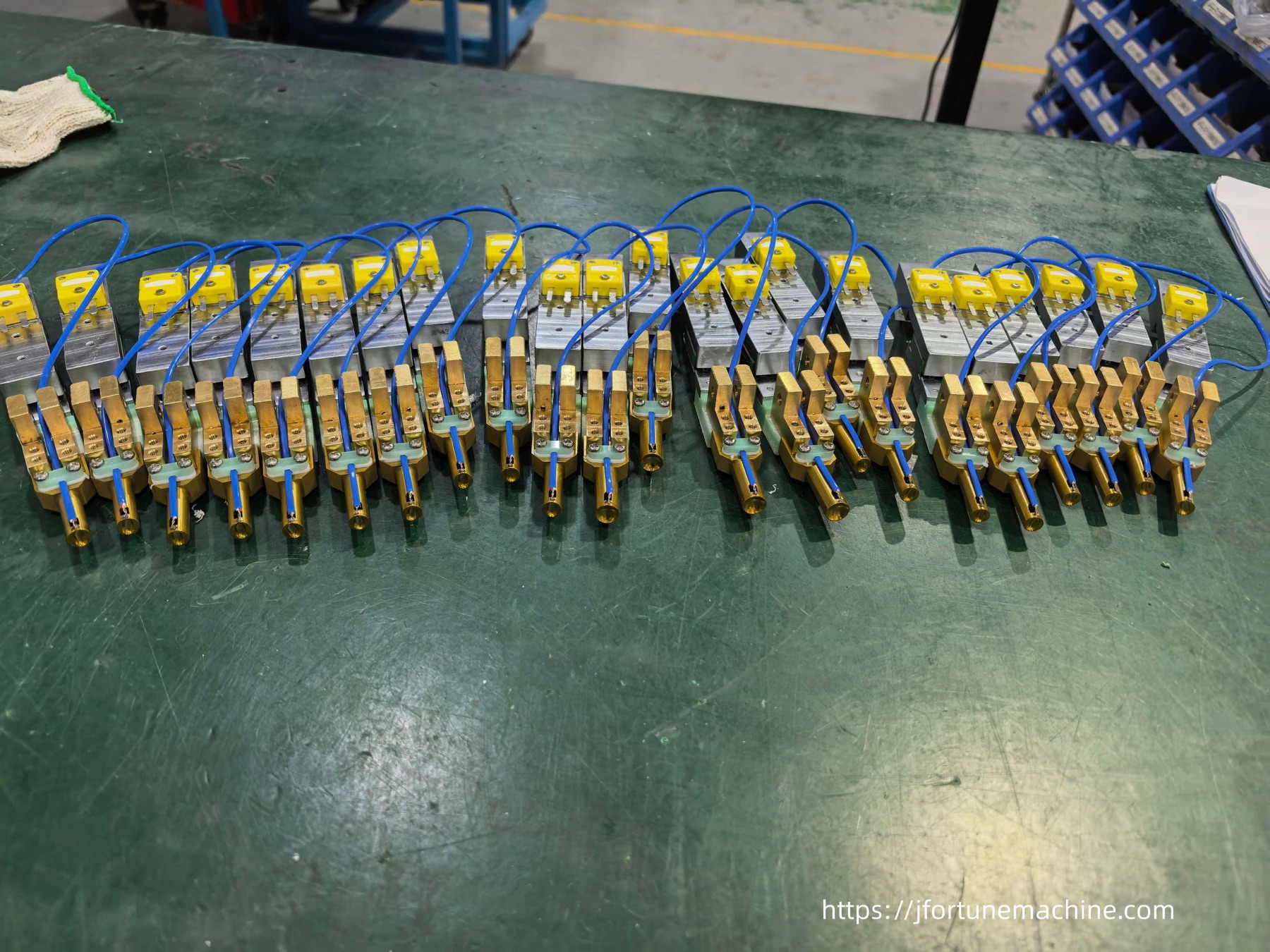
What Is Plastic Pulse Heat Welding Equipment?
Plastic pulse heat welding equipment—often called a pulse heat staking machine—uses an electrically heated forming head to soften a molded thermoplastic post. Controlled force reshapes the post into a rivet-like head that mechanically retains a second component. The head then stops heating, and the joint cools under pressure before release.
Unlike a continuous hot tool, pulse heating applies energy only during the programmed portion of the cycle. This can reduce heat exposure around sensitive surfaces and provides more control over the heat-and-cool profile. The process is a form of thermal staking; it should not be confused with seam welding or with a process that automatically creates a hermetic seal.
How the Pulse Heat Staking Process Works
- Load and locate: the fixture supports the molded part and accurately locates the retained component.
- Approach: one or more staking heads move to the programmed position.
- Heat and form: the head temperature rises while controlled force forms the plastic post.
- Hold and cool: heating stops and the stake cools under pressure; cooling air may be used where appropriate.
- Release and verify: the heads retract and the PLC records available cycle data, alarms or inspection results.
The quality of the joint depends on the entire process window. Peak temperature is important, but so are the heating rate, applied force, forming distance, dwell time, cooling time and the support directly beneath the stake.
Where Pulse Heat Staking Adds the Most Value
- Automotive lighting: retaining bezels, light guides, reflectors, electronics or decorative components where nearby visible surfaces must be protected.
- Electronic modules: securing circuit boards, terminals, sensors and shields without adding screws.
- Interior and exterior trim: assembling decorative layers, brackets, clips and reinforcement parts.
- Appliances and consumer products: joining housings and internal components with repeatable stake geometry.
- Multi-point assemblies: processing several stakes in one station with tooling designed for the actual part layout.
Common candidate thermoplastics include ABS, PC/ABS, PP, PE, PA and other moldable grades. Resin formulation, fillers, pigments, moisture condition and post geometry can change the process response, so representative sample parts should be tested before the final machine specification is fixed.
Pulse Heat Staking vs. Other Plastic Joining Methods
| Process | Best fit | Key consideration |
|---|---|---|
| Pulse heat staking | Forming plastic posts over another component with controlled local heating | Head design and cool-under-pressure time are critical |
| Continuous thermal staking | Stable, straightforward staking applications | Continuous tool temperature can increase heat exposure |
| Ultrasonic staking | Fast cycles on parts that tolerate vibration | Vibration can affect delicate electronics or visible surfaces |
| Soldadura por vibración | Large thermoplastic parts with continuous weld joints | Requires compatible joint geometry and relative motion |
| Soldadura láser de plásticos | Precise, non-contact seams with compatible optical materials | Material transmission and joint access must be validated |
If your assembly needs a continuous structural or leak-tight joint rather than formed stakes, review the vibration welding process and applications or discuss laser welding, hot plate welding and other alternatives with the engineering team.
Seven Specifications That Determine Machine Performance
1. Heating-head geometry and coating
The head profile determines how molten material flows and defines the final stake shape. Dome, rosette, hollow, flush and custom profiles require different tool geometry. Surface treatment and cleanability also affect release and maintenance.
2. Closed-loop temperature control
Temperature feedback should be measured close to the forming area. Ask how recipes, ramp profiles, high/low limits and sensor faults are managed—not only for the maximum temperature printed on a specification sheet.
3. Force and displacement control
Consistent force helps form the stake without excessive collapse. Displacement or final-height monitoring can provide an additional process check when the application requires traceability.
4. Cooling under pressure
The joint should stabilize before the head retracts. Cooling strategy affects cycle time, cosmetic quality and the risk of the newly formed stake lifting or stringing.
5. Fixture support and part protection
A rigid, correctly referenced nest protects the assembly from deflection. Sensitive Class-A surfaces may need soft contact materials, protected loading paths or part-present sensors.
6. Multi-head balance
For multi-point tooling, the system must accommodate normal part tolerances so each stake receives the intended contact and forming condition. Modular head layouts can also simplify service and product changeovers.
7. Controls, traceability and automation
Depending on the quality plan, useful options include recipe control, password levels, barcode selection, cycle-data storage, alarm history, displacement monitoring, vision inspection and integration with a robot or transfer line. Learn more about robotic plastic welding integration.
What to Send for an Accurate Quotation
A useful quotation starts with application data. Sending the following information helps an equipment supplier evaluate risk, choose the correct process and avoid an underspecified machine:
- 3D part files and 2D drawings, including stake dimensions and tolerances
- Plastic resin and grade, fillers, color and any surface treatment
- Photos of the full assembly and all cosmetic surfaces
- Number, spacing and required final shape of the stakes
- Retained component material and thickness
- Required pull, push, torque, leak or appearance acceptance criteria
- Target cycle time, annual volume and shift pattern
- Manual, semi-automatic or fully automated loading preference
- Plant voltage, air supply, safety standard and communication requirements
- Representative sample parts for trials, when available
Buyer tip: Ask for a sample trial and an agreed acceptance plan before final tooling approval. A good proposal should identify the planned stake profile, process variables to be controlled and how joint quality will be verified.
Preguntas frecuentes
Is pulse heat staking the same as plastic welding?
It is a thermal plastic joining process, but its main function is usually to form a molded post into a mechanical retaining head. It does not automatically create a continuous weld seam.
Can pulse heat staking make a watertight joint?
Not by itself in every design. Leak performance depends on the joint geometry, sealing feature and material behavior. If watertightness is required, specify the pressure, medium, test method and allowable leak rate during the project review.
How many stakes can a machine process at once?
Multi-head tooling can process multiple points in one cycle, but the practical quantity depends on stake spacing, available power, access, part tolerance, forming force and maintenance needs. The head layout should be engineered from the actual part.
What determines the cycle time?
Material, stake size, head mass, heating profile, forming distance, cooling strategy, number of points and loading method all matter. A realistic cycle-time commitment requires part trials rather than a generic number.
When should I choose pulse heat staking instead of ultrasonic staking?
Pulse heat staking is often considered when vibration-sensitive electronics, delicate components, visible surfaces or controlled thermal forming are priorities. Ultrasonic staking may be attractive where very fast cycles are required and the assembly tolerates vibration. Sample testing is the best way to compare both methods.
Discuss Your Plastic Assembly with Jfortune
Send your part drawings, resin grade, stake layout, quality criteria and target cycle time. Jfortune can review the application and propose the process, tooling concept, controls and automation level that match your production goals.
Correo electrónico: info@jfortunemachine.com · WhatsApp/Phone: +86 189 6368 7306
 ES
ES  EN
EN  DE
DE  PT
PT  RU
RU  JA
JA  IT
IT  AR
AR  KO
KO