
Quick answer: A 27.12 MHz HF welding process is stable only when the generator, matching circuit, electrode, material load, pressure, time, and cooling work as one system. Correct tuning improves energy transfer. Spark protection limits damage from abnormal arcing, but it cannot replace clean materials, smooth tooling, accurate alignment, and a proven process window.
Terminology: High-frequency (HF) welding is also known as radio-frequency (RF) welding. In this guide, HF refers to the plastic welding process.
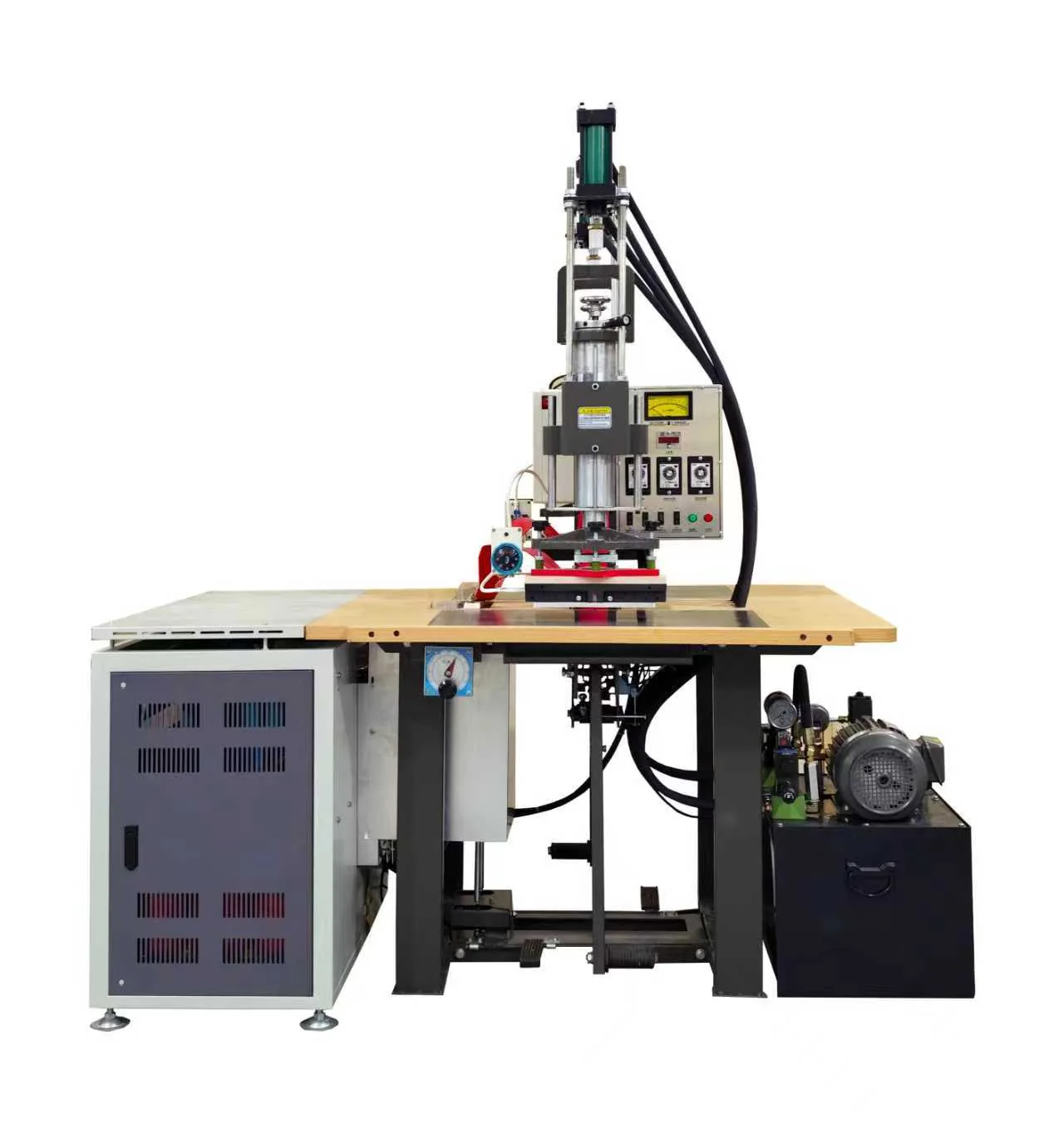
27.12 MHz HF Welding: The Buyer’s Practical View
| Process element | Its job | Warning sign |
|---|---|---|
| Material | Converts HF energy into heat within the weld area | Little heating, uneven melt, or rapid overheating |
| Electrode and fixture | Define the seam and distribute pressure and electric field | Weak corners, deep marks, uneven seam, or repeated arc points |
| Tuning or matching | Transfers energy efficiently to the actual tool and material load | Unstable power, long cycles, or setting changes between similar parts |
| Pressure and time | Bring layers together and hold the joint during heating and cooling | Thinning, squeeze-out, weak bond, or distortion |
| Spark protection | Detects an abnormal discharge and interrupts energy | Tool pits, burned material, nuisance trips, or ignored alarms |
What Does 27.12 MHz Mean?
HF plastic welding uses an alternating electric field to heat suitable dielectric materials. The frequency 27.12 MHz is widely used for industrial HF applications within an internationally recognized industrial, scientific, and medical band. The exact equipment and installation still need to follow the rules that apply at the destination.
The frequency is not a speed guarantee. It does not tell you which machine power, press force, electrode, or cycle time the part needs. Those choices depend on effective weld area, material chemistry, thickness, layer construction, tool geometry, pressure, and the quality target.
PVC and many TPU formulations are common HF-weldable materials. Some coated textiles also respond well. However, additives, pigments, fabrics, foam, adhesive, moisture, and recycled content can change heating behavior. Polyethylene and polypropylene normally do not heat effectively in a conventional HF process. Test the full production stack before specifying equipment.
If you need a basic material and machine overview first, read the high-frequency welding equipment buyer’s guide.
Why HF Tuning Changes With the Tool and Product
The generator does not work alone. The matching circuit, electrode, lower fixture, and material form an electrical load. Change the electrode area, seam shape, material thickness, stack, or fixture, and the load changes. Tuning adjusts the system so energy reaches the weld area in a controlled way.
Poor tuning can look like a material problem. The part may heat slowly, warm unevenly, or need a setting that changes from cycle to cycle. However, similar symptoms can also come from uneven pressure, dirty surfaces, material variation, loose connections, or worn tooling. Troubleshooting should check the complete system instead of adjusting one control repeatedly.
Practical rule: Good tuning is not the highest meter reading. It is stable energy transfer that produces an accepted seam across the normal material and process range.
When should a setup be reviewed?
- After installing a new electrode or fixture
- After a major change in weld area or seam geometry
- When the material supplier, grade, thickness, or layer stack changes
- After maintenance on the generator, matching system, press, or connections
- When arcing, weak spots, heating time, or appearance changes unexpectedly
Saved recipes are useful, but a recipe does not prove that a changed material is equivalent. The buyer should control material changes and define when re-testing is required.
What Causes Arcing in HF Welding?
An arc is an unwanted electrical discharge. It can burn the product, pit the electrode, damage a fixture surface, or stop production. Common contributors include metal particles, dust, moisture, folds, trapped debris, damaged insulation, a sharp tool feature, a loose connection, uneven pressure, an incorrect material stack, or excessive energy concentration.
Repeated arcing in the same location often points to a local cause. Inspect the electrode edge, fixture support, seam overlap, and material condition at that point. Random arcing may suggest contamination, inconsistent loading, or broader setup variation. Operators should record the location and condition rather than simply restart the cycle.
Some products include metal inserts, zippers, conductive printing, or nearby hardware. These features can change the electric field. Show them on the drawing and include them in sample trials. Do not add conductive components after process approval without review.
What Spark Protection Can and Cannot Do
A spark-protection system monitors for an abnormal condition and cuts or reduces HF energy quickly. This can limit the size of a burn and reduce electrode damage. It is valuable because a damaged tool can create repeated defects.
Still, protection is not a substitute for prevention. If the product is folded, contaminated, incorrectly located, or pressed by a damaged electrode, the root cause remains. A setting that trips repeatedly should be investigated. Raising the trip threshold to continue production can hide a process problem.
Practical arc-prevention checklist
- Clean the electrode, fixture, table, and material handling area.
- Inspect the electrode for sharp damage, pits, looseness, and poor alignment.
- Confirm the correct layer stack, overlap, insert position, and recipe.
- Check pressure distribution and fixture support across the complete seam.
- Verify connections, insulation, grounding, and shielding according to the machine instructions.
- Review tuning and energy settings after any tool or material change.
- Record arc location, product lot, operator, tool, and setting before troubleshooting.
How to Build a Repeatable Process Window
A process window is the range of settings that makes an accepted joint, not one lucky setting. Start with production-grade material and an agreed test plan. Evaluate combinations of pressure, HF energy or time, cooling, and any pre-clamp step. Use the buyer’s test method for strength, leak performance, dimensions, and appearance.
Run enough repeated cycles to reveal heating drift, sticking, loading variation, and tool contamination. Then challenge normal material limits, such as permitted thickness tolerance or approved suppliers. The final recipe should sit inside a stable region rather than at the edge of failure.
For products with an integrated cutting edge, tuning must also support clean separation without weakening the nearby seam. See the synchronous high-frequency welding and cutting machine guide. For multi-station flow, use the rotary-table versus sliding-table HF welding machine comparison.
What Machine Buyers Should Specify
Do not select an HF generator from part dimensions alone. The effective electrode area, seam shape, material stack, and process test determine the useful configuration. The press and table must also provide enough space, access, pressure distribution, repeatability, and guarding.
Ask how recipes are stored, how parameter access is controlled, and which alarms are recorded. Define whether the machine must check a product code or barcode. If process data must connect to another system, describe the required fields and interface during quotation.
Destination information matters. Supply voltage and frequency, local safety expectations, language, cooling environment, compressed air, and available floor space can change the design. HF equipment also needs an installation and shielding approach appropriate to the destination. State these requirements before approval.
RFQ Data for Tuning and Spark-Protection Review
- Exact material grade, supplier, and thickness for every layer
- Complete layer structure, including coating, ink, adhesive, metal, and inserts
- Weld-seam drawing with widths, corners, overlaps, and critical zones
- Overall part dimensions and loading orientation
- Estimated electrode or mold area and any existing tool information
- Target good-parts output per hour or shift
- Quality standard, test method, acceptance limits, and traceability needs
- Destination power supply, factory utilities, language, and safety requirements
Frequently Asked Questions
Does 27.12 MHz weld every plastic?
No. The material must respond to dielectric heating. PVC and many TPU formulations are common candidates, while polyethylene and polypropylene normally need another process. Test the exact stack.
Can higher HF power fix a weak seam?
Not necessarily. Weakness may come from incompatible material, poor pressure, incorrect overlap, dirty surfaces, poor tooling, or insufficient cooling. More energy can cause thinning, scorching, or arcing. Diagnose the cause first.
Why does a process arc after running well for hours?
Material debris, tool heating, wear, moisture, a shifted layer, a loose connection, or lot variation may have changed the condition. Record the arc location and inspect the full setup before restarting.
Does spark protection prevent all tool damage?
No. It can interrupt abnormal energy and limit damage, but response and damage depend on the event. Clean setup, good tooling, correct tuning, and routine inspection remain essential.
Ask Jfortune for an HF Process Review
Choose equipment from real process evidence. Send Jfortune your material grade, full layer structure, weld drawing, part dimensions, estimated electrode area, production target, quality standard, and destination power and safety requirements. Add production-grade samples and any current defect photos. The engineering team can review weldability, tooling, tuning, spark-risk controls, and a suitable sample plan.
Request a 27.12 MHz HF Process Review
Technical Reference
- TWI: High Frequency Welding Handbook — independent background on 27.12 MHz dielectric heating and process fundamentals.
 EN
EN  DE
DE  ES
ES  PT
PT  RU
RU  JA
JA  IT
IT  AR
AR  KO
KO