
Quick answer: Choose a sliding-table HF welding machine for flexible loading, simpler changeovers, and clear operator access. Choose a rotary-table system when repeat parts, balanced stations, and higher automation justify the added tooling and controls. Calculate output from the full load-weld-cool-unload cycle, then confirm the choice with a timed sample trial.
Terminology: High-frequency (HF) welding is also known as radio-frequency (RF) welding. In this guide, HF refers to the plastic welding process.
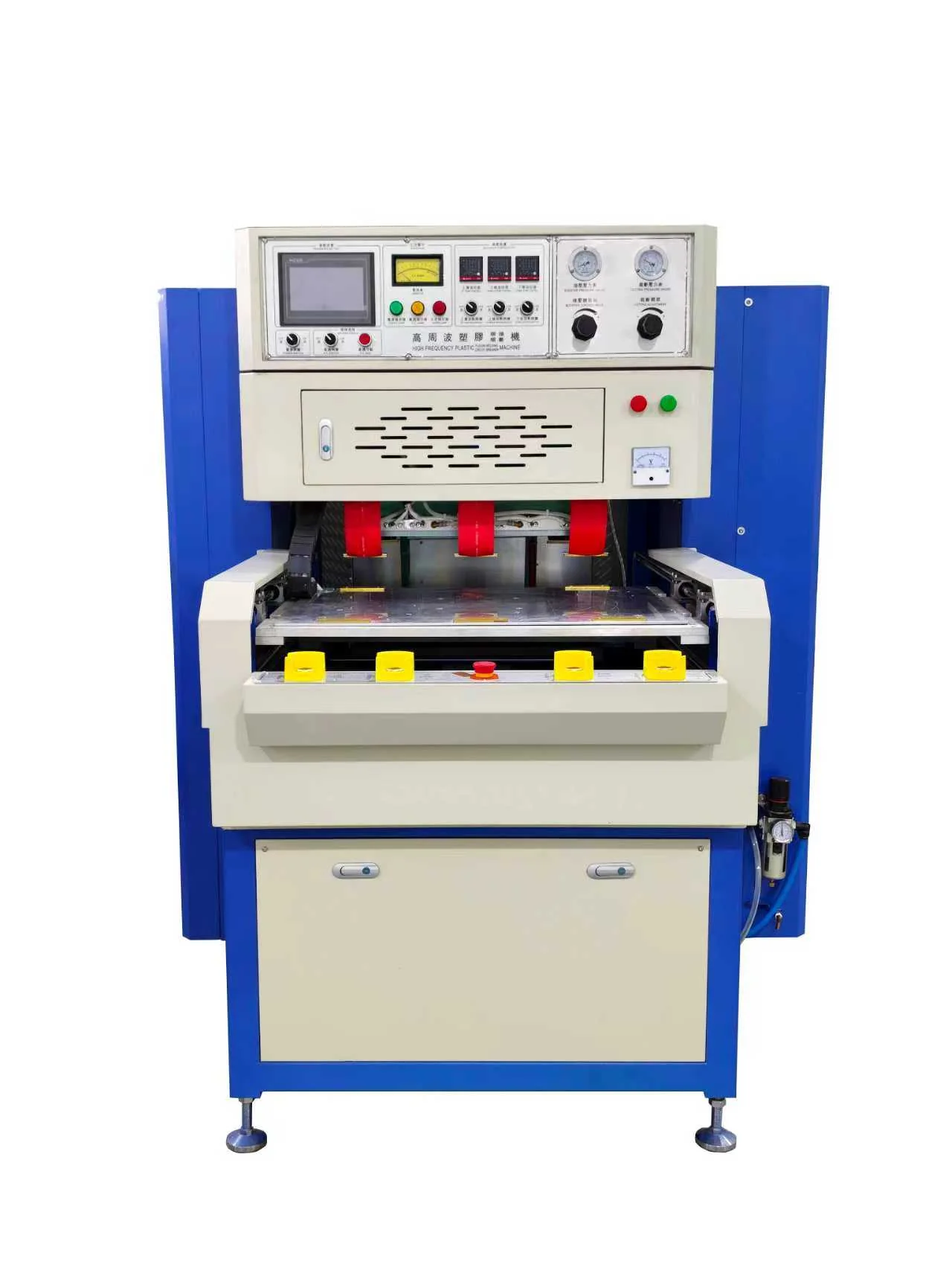
Rotary Table vs Sliding Table HF Welding Machine
| Selection point | Sliding table | Rotary table |
|---|---|---|
| Best fit | Mixed products, clear manual loading, moderate output | Repeat products with balanced multi-station work |
| Material flow | Fixture moves in a straight line between load and weld positions | Fixtures index through defined positions |
| Changeover | Often simpler when one or two fixtures are used | More fixtures and station setup may need more changeover work |
| Automation | Can add clamps, sensors, or loading aids step by step | Well suited to a repeated sequence across several stations |
| Floor space | Longer travel area may be needed | Central indexed layout may need wider guarded space |
| Investment drivers | Table travel, one or two fixtures, and guarding | Indexing system, multiple fixtures, station controls, and guarding |
Begin With the Work Sequence
Machine buyers often compare station counts before they map the operator’s work. That reverses the correct order. First, write every production step: collect layers, scan material, position inserts, align the stack, clamp it, weld it, cool it, release it, remove scrap, unload it, and inspect it. Then measure or estimate the time for each step.
If manual loading takes much longer than the HF cycle, another station may allow useful overlap. If welding and cooling take most of the time, a different table layout may help. However, if inspection or scrap removal is slow, adding stations can simply create a queue. The best layout balances the whole process.
Material and part design still come first. Before selecting either system, confirm that the complete layer stack is suitable for HF heating. The high-frequency welding equipment buyer’s guide explains the material, generator, press, and tooling questions that apply to both layouts.
How a Sliding-Table HF Welding Machine Works
A sliding table carries the fixture from an operator loading position into the protected processing area. The travel may be front-to-back or side-to-side. One table provides a simple sequence. Two working tables may allow the operator to prepare one part while another part is being processed, depending on the safety system and controls.
This layout gives the operator direct access to the fixture. That can be useful for large sheets, flexible layers, shoe components, trim pieces, coated textiles, and products that require careful visual alignment. It can also make tooling inspection and cleaning straightforward.
A sliding table is often a practical choice when product mix is high or changeovers are frequent. Yet “simple” does not mean “basic.” Table repeatability, fixture location, pre-clamping, cable routing, travel sensors, and guarding all affect production quality.
Sliding-table advantages
- Clear manual loading and unloading position
- Good access for layer alignment and fixture adjustment
- Flexible approach for several products and tool changes
- Easy-to-understand straight-line material flow
- Option to add a second work position for overlapping tasks
For examples of this equipment category, see the sliding-table high-frequency embossing and fusing machine guide.
How a Rotary-Table HF Welding Machine Works
A rotary table indexes fixtures from one station to the next. A simple sequence might include loading, processing, cooling, and unloading. Other projects may combine inspection, part presence checks, or automated handling. The exact station count should follow the real process rather than an arbitrary target.
Rotary layouts can suit repeat production because every fixture follows a defined path. They can support task separation, such as one operator loading while another station processes. They can also create opportunities for sensors or automation. However, several matched fixtures must hold parts consistently. Indexing accuracy, station balance, guarding, and service access become more important.
The table should never index while a person or loose material is in an unsafe position. Safety design must match the destination rules and the final production method. The supplier needs to understand operator positions, loading direction, surrounding equipment, and factory material flow.
Rotary-table advantages
- Defined, repeated station sequence
- Potential to separate loading, welding, cooling, and unloading tasks
- Good foundation for stable repeat products
- Possible integration of sensors and handling devices
- Efficient use of processing time when station tasks are balanced
Do Not Compare Output by Welding Time Alone
A quoted welding time is only part of the cycle. Actual good-part output includes every action and every normal delay. Build a cycle model using production samples and trained operator movements. Include material pickup, alignment, barcode checks, pre-clamping, table movement, HF heating, cooling, release, unloading, scrap handling, inspection, and machine reset.
Next, include planned changeovers and realistic rejection. If one fixture takes longer to load than the others, a rotary line may wait at that station. If a sliding-table operator must walk or reach too far, the theoretical overlap may disappear. A short video of the current manual process can help the engineering team understand these details.
Practical rule: The useful production rate is the number of accepted parts produced safely—not the shortest heating timer shown on the HMI.
Compare Tooling Cost and Changeover Risk
A sliding-table system may use one working fixture or a matched pair. A rotary table normally needs a fixture at every active position. More fixtures can improve flow, but they also increase build, adjustment, storage, inspection, and maintenance needs.
If a product family changes often, ask how operators identify the correct fixture and recipe. Define lifting aids for heavy tools, storage locations, connection methods, and checks after installation. Poka-yoke features, sensors, or barcode selection may reduce setup mistakes, but the required functions should be written in the project specification.
For a process that joins and trims the edge in one tool, station cleaning and scrap access become more important. Read the synchronous high-frequency welding and cutting machine guide when integrated cutting is part of the project.
Quality, Tuning, and Spark Protection Apply to Both
Neither table layout can correct an incompatible material or poor electrode. The process still depends on material response, weld area, pressure distribution, tool contact, energy, time, and cooling. Every fixture should locate the part consistently and support the seam.
HF tuning must match the actual electrode and material load. Contamination, wrinkles, uneven contact, sharp edges, or too much energy can increase arcing risk. A spark-protection system can interrupt abnormal energy and reduce damage, but preventive setup and cleaning remain necessary. See 27.12 MHz HF welding tuning and spark protection for more detail.
Buyer Decision Checklist
- Choose sliding table when flexible access, simpler tooling, and product changeovers matter most.
- Consider rotary table when the product is stable, stations can be balanced, and repeat output justifies multiple fixtures.
- Request a timed trial with production-grade materials.
- Compare good-parts output, not only theoretical cycle time.
- Include tooling, guarding, utilities, training, spares, and changeover in total cost.
Information Needed for a Useful RFQ
- Material grade, supplier, and thickness for every layer
- Complete layer structure, including coating, ink, adhesive, and inserts
- Weld-seam drawing and any cutting or embossing requirements
- Part dimensions, weight, loading orientation, and factory space
- Estimated electrode or mold area and number of fixtures
- Good-parts target per hour or shift and planned product mix
- Quality standard, test methods, appearance limits, and data needs
- Destination power, compressed air, language, and safety requirements
Frequently Asked Questions
Is a rotary-table HF welder always more productive?
No. It can improve utilization when station tasks are balanced. Slow loading, inspection, scrap removal, or frequent changeovers can reduce the advantage. Measure the full cycle with the real part.
Can a sliding-table machine use two fixtures?
Yes, some layouts use alternating work positions. The final configuration depends on part size, loading time, table travel, controls, and guarding. Both fixtures must locate and support the part consistently.
Which layout uses less floor space?
It depends on part size, table travel, operator area, guarding, and service clearance. A sliding table may be longer. A rotary table may be wider. Ask for a layout drawing based on your plant.
Can one machine run both welding and embossing tools?
It may be possible when generator capacity, press, table, and controls suit both processes. Each tool and material needs its own trial and approved recipe.
Let Jfortune Compare the Two Layouts for Your Part
Make the table decision with production data. Send Jfortune your material grade, layer structure, weld drawing, part dimensions, estimated mold area, output target, quality standard, and destination power and safety requirements. Include the current work sequence and samples if available. The engineering team can compare tooling, station balance, operator flow, and a suitable trial.
Compare HF Welding Table Layouts
Technical Reference
- TWI: High Frequency Welding Handbook — HF welding fundamentals to use before comparing material-flow layouts.
 EN
EN  DE
DE  ES
ES  PT
PT  RU
RU  JA
JA  IT
IT  AR
AR  KO
KO