
Quick answer: Choose an HF welding machine for medical products only after proving that the exact film, coating, tube, and reinforcement layers form a stable seal. A useful buying trial should confirm seal width, appearance, peel or burst performance, leak control, traceability needs, and a repeatable process window before machine configuration is finalized.
Terminology: High-frequency (HF) welding is also known as radio-frequency (RF) welding. In this guide, HF refers to the plastic welding process.
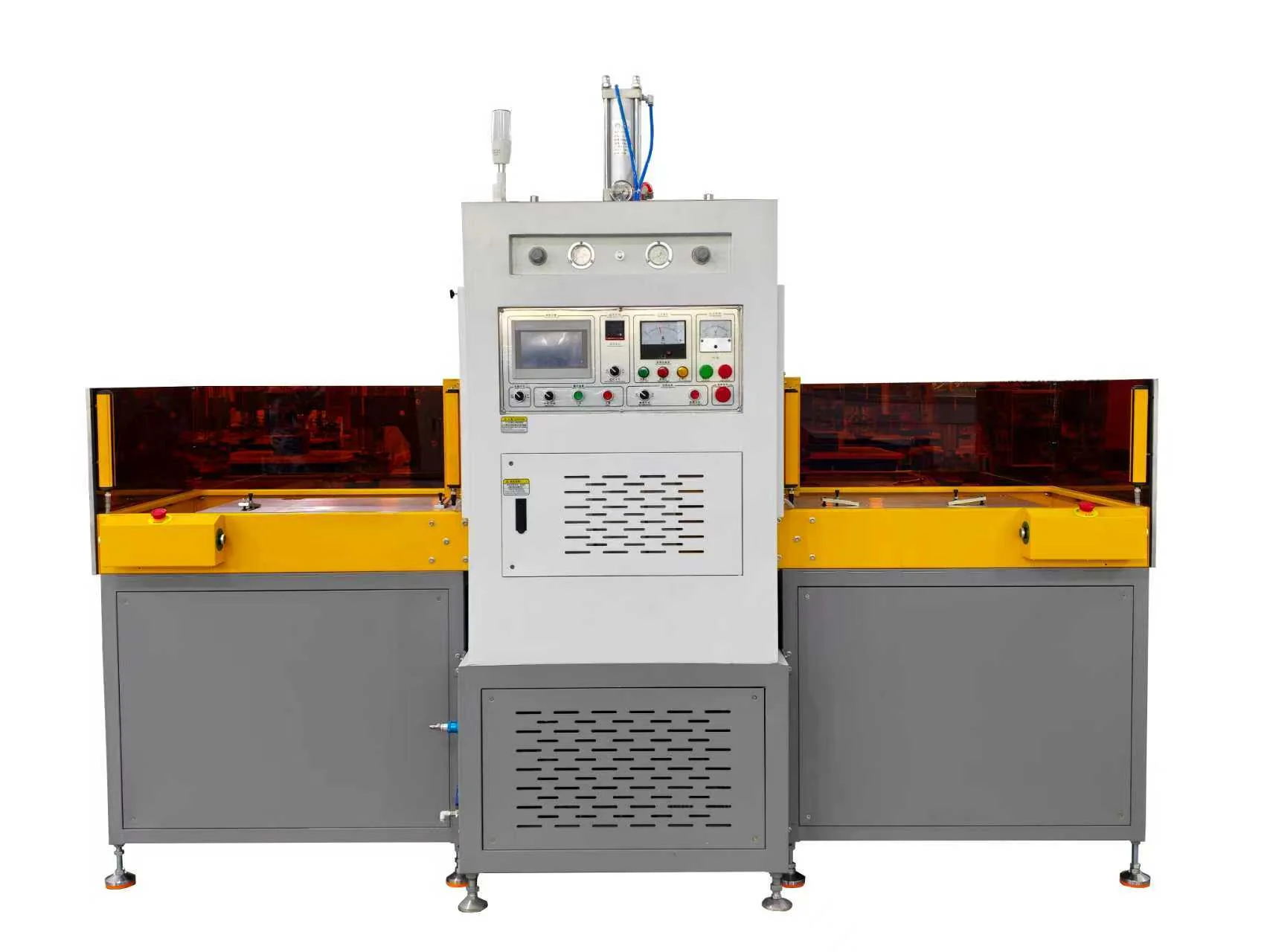
HF Welding Machine for Medical Products: Buyer Selection Checklist
| Buyer question | Why it matters | Evidence to request |
|---|---|---|
| Are all layers HF weldable? | Material chemistry and thickness control heat generation. | A trial using production-grade film, tube, ink, and reinforcement. |
| What must the seal survive? | A cosmetic seam and a pressure-tight seam need different controls. | Approved peel, burst, leak, tensile, or visual criteria. |
| How will parts be located? | Poor positioning causes wrinkles, channel leaks, and variable seam width. | A tooling concept based on the actual drawing and samples. |
| What records are required? | Medical production may need recipe control and process records. | A written list of data, access, alarm, and barcode requirements. |
| What output is required? | Cycle target changes the station layout and loading method. | Good parts per hour, shift pattern, and realistic operator tasks. |
Start With the Medical Product, Not a Machine Model
The phrase medical HF welding machine covers very different applications. A flat fluid bag, an inflatable pressure product, a protective cover, and a tube-to-film assembly do not need the same electrode or fixture. Even two parts that look similar may behave differently because their resin, plasticizer, coating, printing, or storage condition has changed.
For that reason, a responsible supplier should begin with the part drawing and a representative material set. The drawing should show the weld path, acceptable seal width, ports, corners, overlaps, and areas that must remain free of heat marks. Samples should come from the planned production supply chain whenever possible. A sample made from a convenient substitute can create a false result.
HF welding works best with materials that respond well to a changing electric field. PVC and many TPU formulations are common candidates. Some coated textiles can also work. However, a resin name alone is not enough. Additives, thickness, fabric backing, adhesives, inks, and mixed layers can change the heating response. Polyethylene and polypropylene normally need another joining approach unless a specially engineered structure is used.
If you are still comparing processes, read the high-frequency welding equipment buyer’s guide. It explains the basic material and machine choices before you request a quotation.
Define Seal Quality in Numbers
“The seal looks good” is not a complete acceptance rule. A medical-product buyer should turn quality into clear measurements. The exact tests depend on the product and its risk. Common checks include peel strength, tensile strength, burst pressure, pressure decay, vacuum leak, dye penetration, dimensional inspection, and visual limits for scorching, thinning, wrinkles, or exposed reinforcement.
First, state which test method your quality team uses. Next, state the sample conditioning and pass limit. Finally, explain how often the test is required. This information helps the machine supplier propose suitable controls without pretending that one setting can fit every medical part.
Practical rule: A repeatable seal comes from controlled material, controlled tooling, and a measured process window—not from one impressive sample.
The quotation stage should therefore include a trial plan. Jfortune can review the submitted part information and propose a sample test. The trial should explore more than one setting. It should identify a stable range for energy input, pressure, time, cooling, and part location. This range is more useful than a single “best” setting because normal production always includes small variations.
Medical seal evidence to prepare
- Part drawing with weld path and critical dimensions
- Material specification for every layer, including thickness tolerance
- Production samples, ports, tubing, labels, ink, and reinforcement pieces
- Required seal tests, limits, sampling rate, and rejection rules
- Cleanliness, particle, surface-mark, and handling expectations
- Traceability, barcode, recipe, user-access, and data-export requirements
Tooling, Part Location, and Cooling
The HF generator is only one part of the system. The electrode and fixture decide where pressure and energy enter the assembly. A well-designed fixture supports the product, controls overlap, prevents trapped folds, and gives the operator an obvious loading position. It should also allow safe removal without stretching a warm seal.
Thin films can wrinkle during loading. Tubes and ports can roll or lift. Coated fabric may compress differently across a seam. Therefore, the fixture may need location pins, vacuum support, nests, removable inserts, or pre-clamping. The best concept depends on the part. It should not be selected from a catalog photo alone.
Cooling matters because the seam is still soft immediately after heating. Pressure may need to remain until the joint becomes stable. If the part moves too early, the seam can narrow, distort, or pull apart. Buyers should ask how the proposed cycle controls cooling and when the clamp releases.
For applications that combine welding with accurate edge cutting, compare a dedicated medical configuration with a synchronous high-frequency welding and cutting machine. Integrated cutting can simplify alignment, but only if edge particles, tooling wear, and finished-part requirements are acceptable.
Validation Is a Joint Project
A machine supplier can provide machine documents, sample settings, and test support. However, the medical manufacturer owns the final product requirements and validation plan. If your quality system calls for installation, operation, and performance qualification, list the required deliverables before the order. Do not assume that every machine package includes the same document set.
Useful requirements may include an operating manual, electrical and pneumatic drawings, component list, calibration-related information, alarm list, password levels, recipe controls, maintenance instructions, spare-parts list, and factory acceptance test protocol. Some projects also require data capture, barcode checks, user logs, or connection to a factory system. Each item affects engineering scope and should appear in the quotation.
Also define change control. A new film supplier, thickness, pigment, coating, printed area, or port design may require a new welding study. Saving a recipe does not prove that a changed material will produce the same seal.
Choose the Right Production Layout
A single station can suit lower-volume work, frequent product changes, or careful manual assembly. A sliding table can separate loading from the weld area and provide a clear operator workflow. A two-station or rotary layout may improve utilization when loading time is longer than the welding cycle. However, more stations also add fixture cost, floor-space needs, guarding, and process coordination.
Ask for a cycle breakdown rather than a headline speed. Include loading, scanning, pre-clamping, welding, cooling, unloading, inspection, and changeover. The slowest real task often determines output. The comparison in rotary-table versus sliding-table HF welding machines can help you choose a practical material flow.
Information needed for an accurate RFQ
- Material grade, supplier, and thickness for every layer
- Layer structure and any coating, ink, adhesive, tube, or insert
- Weld-seam drawing with dimensions and critical quality areas
- Overall part size, loading orientation, and available plant space
- Electrode or mold area, or enough data for Jfortune to estimate it
- Required good-parts output per hour or per shift
- Quality standard, test method, pass limit, and document needs
- Destination voltage, frequency, plug, language, and safety requirements
Frequently Asked Questions
Can one HF welding machine run several medical products?
Often yes, if the generator range, press, table, guarding, and control system suit every product. Each part normally needs dedicated tooling and an approved recipe. Large differences in material, weld area, or loading method may make separate configurations more practical.
Does an HF welded seam automatically become airtight?
No. Airtight performance depends on material compatibility, seam design, cleanliness, pressure distribution, energy, cooling, and part location. The finished assembly must pass the buyer’s defined leak or pressure test.
Can Jfortune quote from a photo?
A photo can start the discussion, but it is not enough for a reliable configuration. A useful quotation needs the material stack, drawing, seam size, part dimensions, output target, quality criteria, and destination utilities.
Should we buy the highest available HF power?
No. Power should match the effective weld area, material response, electrode design, and process window. Excess capacity does not correct poor tooling or incompatible materials. A sample study is the safer basis for selection.
Send Your Medical Product for a Process Review
Reduce purchasing risk before you order. Send Jfortune your material grade, full layer structure, weld-seam drawing, part dimensions, estimated electrode area, production target, quality standard, and destination power and safety requirements. If possible, also send production-grade samples. The engineering team can review weldability, tooling, station layout, controls, and an appropriate test plan.
Request an HF Welding Process Evaluation
 EN
EN  DE
DE  ES
ES  PT
PT  RU
RU  JA
JA  IT
IT  AR
AR  KO
KO