
Quick answer: The right high-frequency welding machine for automotive interiors depends on the exact surface material, backing, seam shape, visible-area standard, part size, and output target. Prove weldability and appearance with production-grade samples first; then select the press, table layout, tooling, controls, and handling method around the approved process window.
Terminology: High-frequency (HF) welding is also known as radio-frequency (RF) welding. In this guide, HF refers to the plastic welding process.
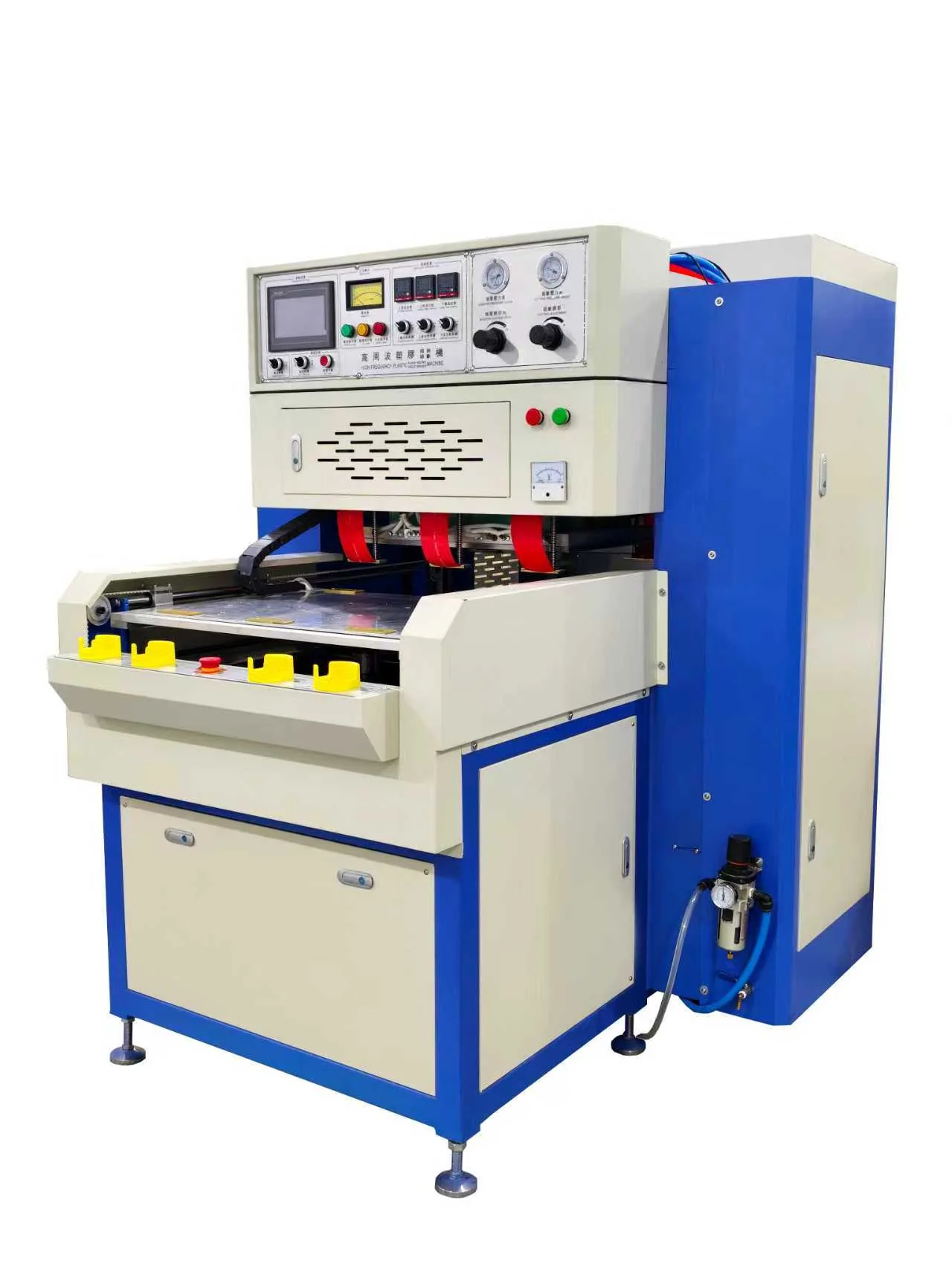
High-Frequency Welding Machine for Automotive Interiors: Key Decisions
| Decision | Buyer should provide | What the trial should prove |
|---|---|---|
| Material compatibility | Skin, foam, fabric, coating, adhesive, insert, and thickness | Stable heating without burning, weak bonding, or surface damage |
| Visible appearance | Grain, color, gloss, permitted witness marks, and seam tolerance | Consistent emboss depth, edge definition, and acceptable marking |
| Part positioning | Three-dimensional drawing, datum points, and trim condition | Repeatable alignment without wrinkles or trapped layers |
| Production flow | Good parts per hour, loading steps, changeovers, and inspection time | A realistic cycle that includes operator work and cooling |
| Quality control | Peel, tensile, dimensional, visual, and traceability rules | A measurable process window and a clear acceptance plan |
Which Automotive Interior Parts Can Use High-Frequency Welding?
High-frequency welding, also called HF welding, is used when the material responds to dielectric heating and the product needs a clean, controlled seam or embossed feature. Possible interior applications include floor mats, seat and trim details, door-panel components, storage pockets, sun-visor parts, protective covers, and selected coated-fabric assemblies. The process can also combine joining with decorative embossing.
However, the application name does not prove that the material can be welded. PVC and many TPU-based materials are common HF candidates. Some polyurethane-coated textiles may work when the coating and construction are suitable. Polyolefin materials such as polyethylene and polypropylene normally respond poorly to conventional HF heating. Mixed stacks can also create problems when one layer heats quickly and another layer insulates or moves.
Therefore, buyers should send the complete material stack, not just the visible skin. Include foam, scrim, reinforcement, adhesive, paint, ink, and any molded insert. Also explain whether the parts arrive warm, cold, aged, or pre-formed. These details can change the result.
For a broader overview of HF machine types and material questions, start with the high-frequency welding equipment buyer’s guide.
Appearance and Strength Must Be Evaluated Together
Automotive interior parts are often judged at arm’s length and under changing light. A seam can be mechanically strong but still fail because it is uneven, glossy, scorched, too deep, or poorly aligned with the grain. On the other hand, a neat surface does not prove that hidden layers are bonded strongly enough.
A useful sample trial should therefore separate visible requirements from structural requirements. Define the accepted seam width, emboss depth, pattern position, edge radius, gloss change, color change, and witness marks. Then define peel or tensile limits, dimensional stability, ageing conditions, and any environmental test required by the buyer.
Practical rule: For a visible interior part, the process window must protect both the bond and the surface. Neither requirement should be judged from appearance alone.
During the trial, record a range of settings rather than one good cycle. Normal production includes small differences in material thickness, temperature, moisture, and operator loading. A stable process should remain acceptable across an agreed operating range. If it only works at one narrow setting, production risk is high.
Common defects to discuss before quotation
- Wrinkles or trapped air near curved seams
- Surface scorching, gloss change, or color shift
- Uneven emboss depth across a large electrode
- Weak corners, narrow areas, or transitions in seam width
- Excess squeeze-out or thinning beside the weld
- Misalignment between grain, stitching, printed marks, and tooling
- Arcing around metal inserts, contamination, or sharp electrode edges
Tooling Controls the Part, Pressure, and Pattern
The electrode delivers HF energy and pressure to the selected area. Its shape affects energy concentration, appearance, and seal consistency. The lower fixture supports the assembly and controls its location. For a contoured interior part, the fixture may need shaped nests, vacuum support, removable blocks, datum features, or pre-clamps.
Large decorative areas require especially careful pressure distribution. A small height difference can produce a deep mark in one area and a weak bond in another. Tool rigidity, parallelism, material compression, and the condition of the support surface all matter. Buyers should ask how the tooling will be checked and how wear items can be replaced.
Cooling under pressure may be needed to hold the shape after heating. The cycle should allow the material to stabilize before the part is removed. Otherwise, the operator can stretch a warm seam or change the emboss shape during unloading.
If a finished edge must be formed in the same operation, see the guide to a synchronous high-frequency welding and cutting machine. Integrated weld-and-cut tooling may reduce alignment steps, but its suitability must be proved on the actual stack.
Choose a Table Layout Around Real Operator Work
A fixed single station can suit development, small batches, or frequent tooling changes. A sliding table moves the loaded fixture into the protected weld area. It can provide a simple and visible workflow for larger panels. Two working positions can allow loading at one station while another part is processed, depending on the safety and control design.
A rotary table supports a repeated sequence across several indexed positions. It may suit stable, higher-volume production with balanced loading and unloading tasks. However, it also needs more coordinated tooling, indexing, guarding, and maintenance. The fastest-looking layout is not automatically the best choice.
Compare each option with a full time study. Include part preparation, scanning, loading, alignment, pre-clamping, welding, cooling, unloading, visual inspection, and rejected-part handling. Use the rotary-table versus sliding-table HF welding machine guide to organize this decision.
Controls, Safety, and Factory Integration
Before requesting a quotation, explain how the machine will fit into the plant. State the destination voltage and frequency, available compressed air, floor-space limit, operator direction, material flow, and local safety requirements. Also define the desired interface language and units.
Recipe control can help repeat approved settings. Password levels can reduce unintended changes. Alarms can guide troubleshooting. Barcode or product-code checks may help select the correct recipe. Still, controls do not replace material verification or good tooling. The buyer should define which parameters must be recorded and how long data must be retained.
Spark protection is another important discussion. Arcing can damage the product or electrode when there is contamination, excessive energy concentration, poor contact, or a tooling problem. A protection system can reduce damage by detecting abnormal conditions and interrupting the cycle, but it cannot make an unsafe setup risk-free. Clean material, smooth tooling, correct location, and a tested setting remain essential.
RFQ Information That Prevents Delays
- Exact material grade and supplier for the surface and every backing layer
- Full layer structure, thickness, coating, adhesive, ink, and insert details
- Two-dimensional and three-dimensional drawings with weld or emboss path
- Overall part dimensions, weight, datum points, and loading direction
- Estimated electrode or mold area and required pattern depth
- Good-parts output per hour, shift plan, and expected changeover frequency
- Visual, mechanical, dimensional, ageing, and traceability standards
- Destination power supply, compressed air, language, and safety requirements
Frequently Asked Questions
Can one high-frequency machine produce several interior parts?
Possibly. The machine capacity, press size, table travel, guarding, and controls must cover every part. Each product normally needs its own electrode, fixture, recipe, and approval. Very different part sizes or materials can justify separate equipment.
Is HF welding suitable for natural leather?
HF welding depends on dielectric material response. Natural leather by itself is not a standard HF-weldable thermoplastic. Decorative pressing may use heat and pressure, while coated or laminated constructions need individual testing. Send the complete stack for evaluation.
Can the same machine emboss and weld?
It can be possible when the material, pattern, electrode, pressure, and process sequence are suitable. The trial must prove both appearance and bond performance. Do not assume that a decorative sample represents a production-ready joint.
What is the best station layout for automotive parts?
There is no universal best layout. Sliding tables are often simple and flexible. Rotary tables can support a repeated multi-step flow. The right choice comes from part size, operator tasks, tooling cost, target output, floor space, and safety design.
Ask Jfortune to Review Your Interior Part
Turn your part requirements into a testable machine specification. Send Jfortune the material grade, complete layer structure, seam or emboss drawing, part dimensions, estimated tooling area, production target, quality standard, and destination power and safety requirements. Production-grade samples are strongly recommended. The engineering team can then review weldability, tooling, layout, controls, and a suitable sample plan.
Request an Automotive Interior Process Review
Technical Reference
- TWI: High Frequency Welding Handbook — background on dielectric heating, materials, electrodes and process control.
 EN
EN  DE
DE  ES
ES  PT
PT  RU
RU  JA
JA  IT
IT  AR
AR  KO
KO